2026 Fall Pilot Program: Buy PD, Get Curriculum Free!
Equip your high school students with the essential coding and tech skills they need for success in college, careers, and beyond. Our easy-to-implement computer science curriculum features standards-aligned lessons, hands-on projects, and immersive VR integration, bringing technology to life while fostering creativity, critical thinking, and collaboration. Here’s why both you and your students will love it!
Our curriculum is both spiraled and linear, allowing students to master key concepts while progressing through the course. As they advance, they'll complete both team and independent projects with confidence. Have students who have already mastered certain topics? The curriculum is flexible enough to meet them where they are! Explore the scope and sequence for our high school curriculum below.


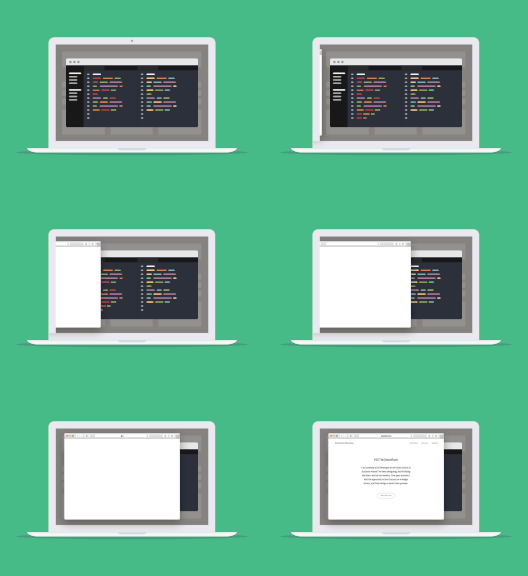
Objective: Students learn web development fundamentals by building and programming a dynamic fan page using HTML, CSS, and JavaScript.
Introduction to Web Development: Students start by using HTML to structure the content of their fan page and CSS to style it, creating a visually appealing and user-friendly layout.
Interactive Features with JavaScript: Students then learn JavaScript to add animations and interactive elements, like image sliders and interactive lists.
Personalized Project: Students can choose a theme for their fan page, such as their favorite band, movie, or sports team, and customize their site to reflect their creativity while mastering key web design principles.


High school computer science teaches students to program in real languages, work with data, and understand how computing systems work, through courses ranging from introductory to specialized tracks like web development, data science, and IT. Courses typically emphasize building real projects and understanding the impact of technology on society. Hello World's high school courses include Intro to Python, Web Development, Data Science & AI, Principles of IT, and CS Dimensions with VR.
A complete high school CS curriculum offers a pathway, not a single course: an introductory class open to every student, then options that go deeper into programming, data, web, or IT. Each course should include full lesson plans, pacing guides, projects, and assessments aligned to state standards. Hello World's high school pathway lets students start with CS Dimensions with VR or Intro to Python and advance to Data Science & AI, where they build tools like handwriting recognition and autocorrect. Download the scope and sequence to see the full progression.
At minimum, an introductory course accessible to all students, plus at least one course that teaches a text-based language. From there, schools add tracks based on student interest and local workforce needs: web development, data science, IT, cybersecurity. Hello World covers each of these: Web Development (HTML, CSS, JavaScript), Intro to Python, Data Science & AI, Principles of IT, and CS Dimensions with VR, which includes cybersecurity principles and data analysis.
An intro course is designed for students with no background. It covers how computers work, programming fundamentals, data, and the societal impact of computing, and it's often the on-ramp to more advanced courses. Hello World's CS Dimensions with VR (grades 8-10) fills this role, covering algorithms and programming, cybersecurity principles, data analysis, and computing impacts while students build in immersive virtual environments. Students with prior CS experience can start directly in Intro to Python or Web Development.
Requirements vary by state. Many states now require every high school to offer CS, and a smaller but growing number count it toward graduation or allow it to satisfy a math or science credit. Even where it isn't mandated, offering CS is increasingly expected by families, and it strengthens college and career readiness metrics. Hello World's standards alignment maps every course to CSTA and state-specific standards so you can document compliance.
Introductory courses are designed for students with no background, and success depends more on persistence and problem-solving than prior math ability. Text-based programming courses are more demanding and work best after an introductory course. The biggest factor in student success is a well-prepared teacher, which is why professional development is central to how Hello World supports schools. Read more on how student agency drives outcomes.
Usually, yes, though some states now allow CS to fulfill a core math, science, or foreign language requirement, and a few have made it a graduation requirement. Check your state's policy; positioning CS as a credit-bearing option rather than a pure elective tends to increase enrollment.
Teacher certification for CS varies widely by state. Some require a dedicated CS endorsement, others allow math, science, or CTE teachers to teach it with additional PD. Hello World's professional development is built for teachers with no programming experience and includes a dedicated PD specialist, so schools can build capacity with existing staff rather than hire for a hard-to-fill position.
Hello World provides a full high school pathway, from CS Dimensions with VR through Intro to Python, Web Development, Data Science & AI, and Principles of IT, plus teacher professional development and implementation support through the pilot program. Students showcase their work at end-of-year events. See our impact or schedule a demo.