2026 Fall Pilot Program: Buy PD, Get Curriculum Free!
Students bring a favorite book scene to life as an interactive 360° world while exploring how AI generates images and text, ending in a Book Fair.
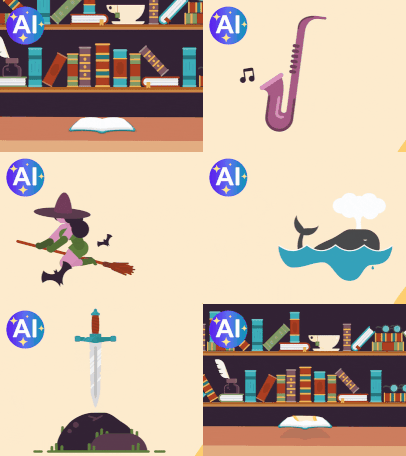


AI Book Hook is aligned to the CSTA K–12 Computer Science Standards, with emphasis on Impacts of Computing and AI literacy within our full K-12 AI literacy curriculum. Students explore how AI systems are trained, consider the implications of non-deterministic outputs, and apply computing tools—including event-driven programming—to build original, interactive creative work.

Provides pacing suggestions, key vocabulary, discussion prompts, and differentiation tips to support student choice while ensuring alignment with learning goals.

These student-facing slides walk students through each phase of the project and include embedded prompts, key concepts, and workbook activities.

A student guide for Session 3's Book Fair, including instructions for visiting classmates' worlds and completing the reflection sheet.

Three pre-built AI Book Hook examples (Treasure Island, The Odyssey, and Pride and Prejudice) for use as extra Book Fair booths or a class demonstration.


AI storytelling is using generative AI as a creative collaborator: to brainstorm plot ideas, develop characters, draft scenes, or generate images and environments that bring a story to life. The author still makes the decisions; the AI expands the possibilities. In Hello World's AI Book Hook course for grades 6-12, students use AI to craft sequels to books they've read and then build those stories as immersive VR worlds.
Set the AI up as a collaborator, not a ghostwriter. Students start from a story they know, use AI to generate "what happens next" possibilities, evaluate which ideas fit the characters and themes, and then write and build the version they choose. That process teaches both creative writing and AI literacy: students learn to prompt well, judge outputs, and keep authorship. AI Book Hook structures the whole sequence with lesson plans and a Code of Ethics for student work.
It removes the blank page and adds options. Students who freeze at "write a story" can react to AI-generated ideas, reject the weak ones, and improve the strong ones, which is a real editorial skill. Hello World's approach is that students use AI to breathe more life into their own ideas, not to offload creative work, and the assessment focuses on the choices students made.
Students write sequels to classic works in the public domain. Because the source texts are classics, the course fits naturally into ELA units teachers already run.
Both. ELA teachers use it to deepen engagement with literature and teach narrative structure; CS teachers use it to teach AI literacy and virtual world-building. It's one of Hello World's AI literacy modules and requires no programming background to teach. Students program their VR scenes with the same block-based tools used across Hello World's courses.
AI Story Studio (grades 3-12) has students create original stories with AI. AI Book Hook (grades 6-12) has students extend existing literature by writing sequels, which makes it a stronger fit for ELA classrooms and older students. Both teach the same AI literacy core: learn about AI, co-create with it, and program with it.
Yes. All AI interaction happens inside Hello World's platform, protected by four layers of AI safety, with teacher access controls. Students don't need accounts on commercial AI tools. See the data security overview.