Web Development Curriculum

Web Development

  • Grades 6-8
  • Year-round

Web Development introduces students to the core technologies used to create modern websites.
Web Development
Grades 6-8
HTML/CSS/JS
CSTA 6-8
CSTA 9-10
Text-based
HTML/CSS/JS

Course Overview

Students build progressively more advanced web projects while learning HTML, CSS, and JavaScript. They explore key concepts in web structure, styling, interactivity, and user experience design. Through guided, team, and independent projects, students develop skills in web programming, responsive design, and user-centered design thinking. No prior coding experience is required.
No items found.
Example Project: 
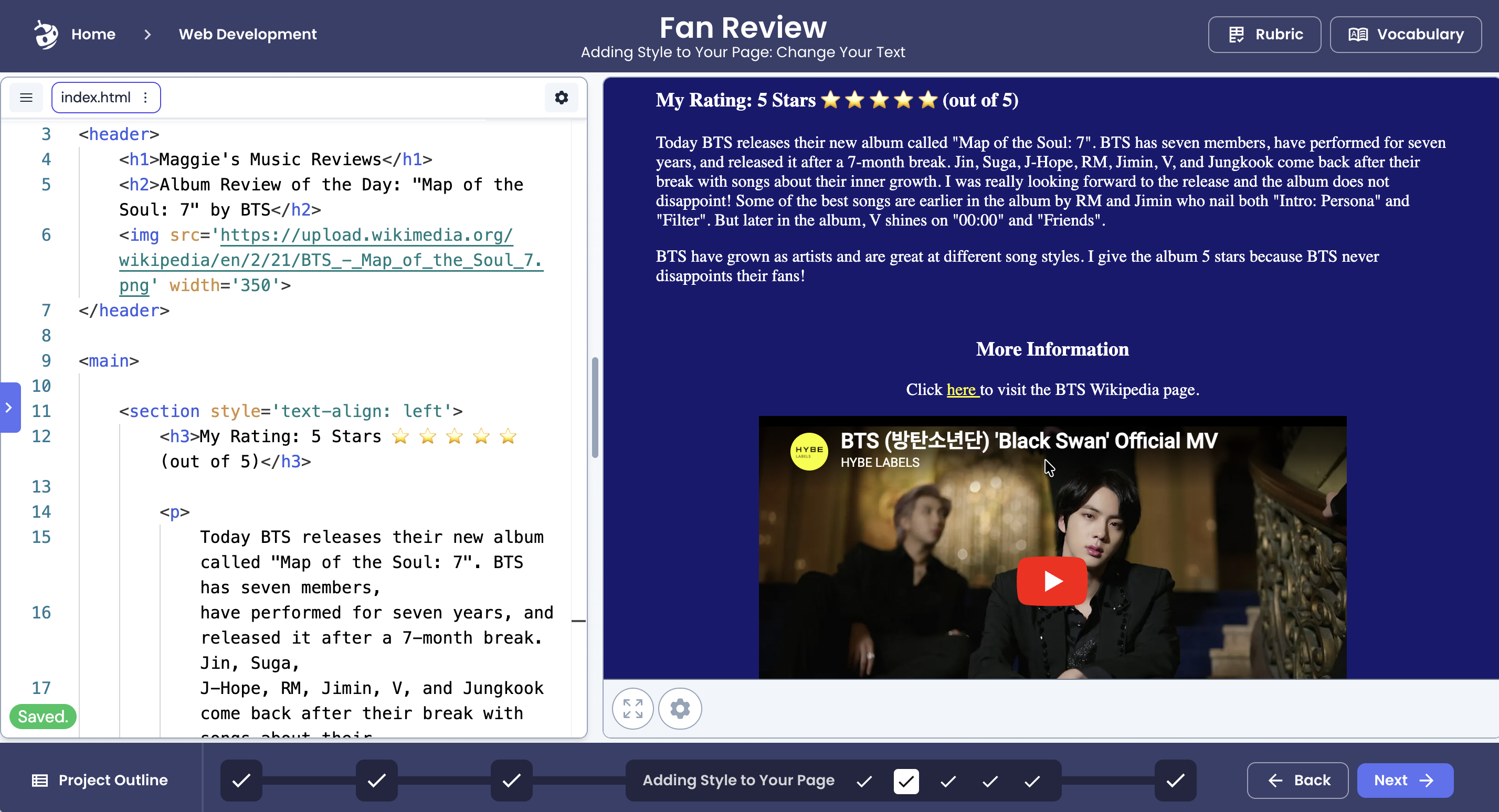
Fan Review

Learning Goals

Students will:
  • Learn and apply core web development concepts using HTML, CSS, and JavaScript
  • Design and build interactive, multi-page websites with custom styling and dynamic content
  • Use computational thinking to structure, test, and refine website logic and user experience
  • Practice debugging, testing, and iteration to improve project outcomes
  • Collaborate on team-based web projects and coding challenges
  • Explore web design principles such as layout, visual hierarchy, accessibility, and user experience
  • Reflect on the societal impact of the web and responsible design practices

Join the Fall Pilot

Get Started

CSTA Alignment

Web Development is aligned to the CSTA 6-8 and 9-10 Computer Science Standards. The course provides opportunities for middle and high school learners to build foundational and advanced skills in web programming, design, and interactivity. Students explore algorithms, variables, functions, events, and responsible computing through project-based learning in HTML, CSS, and JavaScript.

Curriculum Standards Alignment

Course Resources

Projects include resources to...

Lesson Plans

Provides pacing suggestions, key vocabulary, discussion prompts, and differentiation tips to support student choice while ensuring alignment with learning goals.

Teacher Slides

These student-facing slides walk students through each phase of the project and include embedded prompts, key concepts, and workbook activities.

Project Example

Helps teachers support students, model expectations, demonstrate creative possibilities and accurate use of the code.

Example Code

Supports debugging during instruction and offers a reference point for students building their own projects.

Project Rubric

Aligned to the project's learning objectives and includes grading criteria for creativity, collaboration, and technical proficiency.

Student Workbook

Students use workbooks (print or digital) to record their project ideas, explain their coding choices, and reflect on what they've learned.

View All Curriculum

Sign up for free this school year!

Get access to free projects now, or schedule a call for a district-wide deployment.