2026 Fall Pilot Program: Buy PD, Get Curriculum Free!
Help your students develop key computer science skills with a curriculum that's easy to follow and fun to teach. Our hands-on, standards-aligned lessons include interactive activities, teamwork, and VR integration, bringing lessons and projects to life for an engaging, immersive learning experience. Here’s why both you and your students will love it!
Our curriculum is both spiraled and linear, allowing students to master key concepts while progressing through the course. As they advance, they'll complete both team and independent projects with confidence. Have students who have already mastered certain topics? The curriculum is flexible enough to meet them where they are! Explore the scope and sequence for our elementary curriculum below.
Download Scope & Sequence

Objective: Students learn the basics of coding and virtual world-building while designing and programming their very own virtual class pet!
Introduction to Programming: Students will use blocks of code to program their pet's actions, including walking, jumping, and playing.
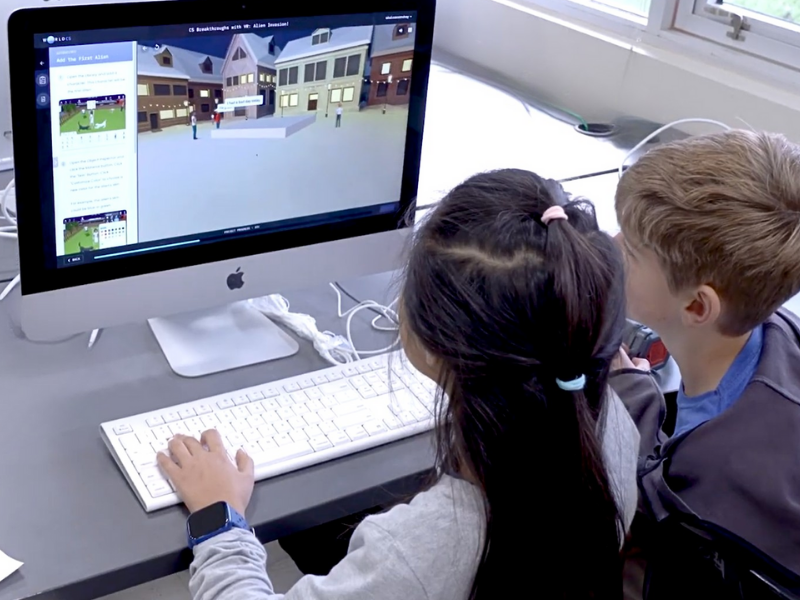
Immersive VR Experience: The class pet comes to life in a 3D virtual world, giving students an opportunity to see their code in action.
Teamwork Challenge: Students will work in pairs to design their pets and combine their ideas to create an interactive virtual space.
Whether students are coding their first virtual world in elementary school or building data tools in Python by senior year, our curriculum meets them where they are and gives them a clear path forward.


An elementary computer science curriculum introduces computational thinking (patterns, sequencing, decomposition, and simple algorithms) alongside coding basics like loops, variables, and conditionals, plus digital citizenship and safe internet use. Hello World's elementary sequence is two courses: CS Adventures with VR for grades 1-3, where students code stories in virtual worlds, and CS Breakthroughs with VR for grades 3-5, which adds introductory programming and data concepts. Both align to CSTA K-2 and 3-5 standards.
At the elementary level, computer science is about computational thinking: recognizing patterns, breaking problems into steps, following and writing simple instructions, and understanding how computers represent information. Students typically work in block-based coding environments. In Hello World's curriculum, students design and program their own virtual class pet, then see their code come to life in a 3D world. No prior experience is required from students or teachers. If you're wondering whether block coding counts as real programming, we wrote about that.
Early exposure matters most for the students least likely to encounter CS at home. Research consistently shows that attitudes about who "belongs" in computing form early, and that girls and students of color who start CS in elementary grades are more likely to continue. It also builds the reasoning habits that support math and literacy. Hello World's mission centers on eliminating barriers to learning, especially in marginalized communities. See our impact.
Hello World's curriculum is both spiraled and linear, so it works as a weekly specials rotation, a dedicated CS block, or integrated into existing subjects. Concepts build on one another, and the curriculum is flexible enough to meet students where they are if they've already mastered certain topics. The free Interdisciplinary Quests, like Eco-Resilient Explorers for grades 3-5, let classroom teachers fold CS into science and math units without a separate period. Download the scope and sequence for pacing details.
Most often, classroom teachers, technology or library media specialists, or a dedicated STEM teacher. None of those roles typically come with a CS background, which is why Hello World's elementary curriculum is scripted for a seamless first-year rollout, with lesson plans, pacing guides, and professional development that assume the teacher is learning alongside the students.
Hello World's elementary courses run in the browser on standard classroom devices, including iPads and Chromebooks. VR headsets enhance the experience but aren't required; students can view their virtual worlds on any screen. For screen-free options, Hello World also offers unplugged activities. Check the tech requirements for specifics.
Grades 1 through 5, across two courses: CS Adventures with VR (grades 1-3) and CS Breakthroughs with VR (grades 3-5). Students in grades 3-5 can also start AI Story Studio and the free AI 360°. Download the course overview for unit-level detail.