2026 Fall Pilot Program: Buy PD, Get Curriculum Free!

Whether students are exploring AI for the first time through creative storytelling or tackling data science in high school, our curriculum fosters curiosity, creativity, and critical thinking skills.


Projects lead with immersive, explorable, and interactive explanations through which students come to learn about AI and how to responsibly use it.

Students use AI not to offload their creative work, but to breathe even more life and energy in their ideas.

Students define, customize, and use their own AI-enabled code to write block-based programs that bring their sequels to life.


AI literacy is the ability to understand how artificial intelligence works, use it effectively and responsibly, and evaluate its outputs critically. For K-12 students that means knowing what AI can and can't do, recognizing when they're interacting with it, understanding how it's trained and where bias comes from, and making sound judgments about when to rely on it. It is not the same as learning to prompt a chatbot; that's one small skill inside a much larger set. Hello World's approach has students learn about AI, co-create with it, and program with it, so they understand it as a tool they direct rather than a black box. Read more in AI Literacy in K-12 Education.
Students are already using AI daily, usually without any instruction. Without AI literacy they tend to over-trust outputs, miss errors and bias, and use tools in ways that shortcut learning. With it, AI becomes something they can reason about and direct. It's also increasingly a workforce expectation. Employers across every sector, not just tech, now list AI skills as baseline. Schools that build AI literacy early are preparing students for the world they'll graduate into.
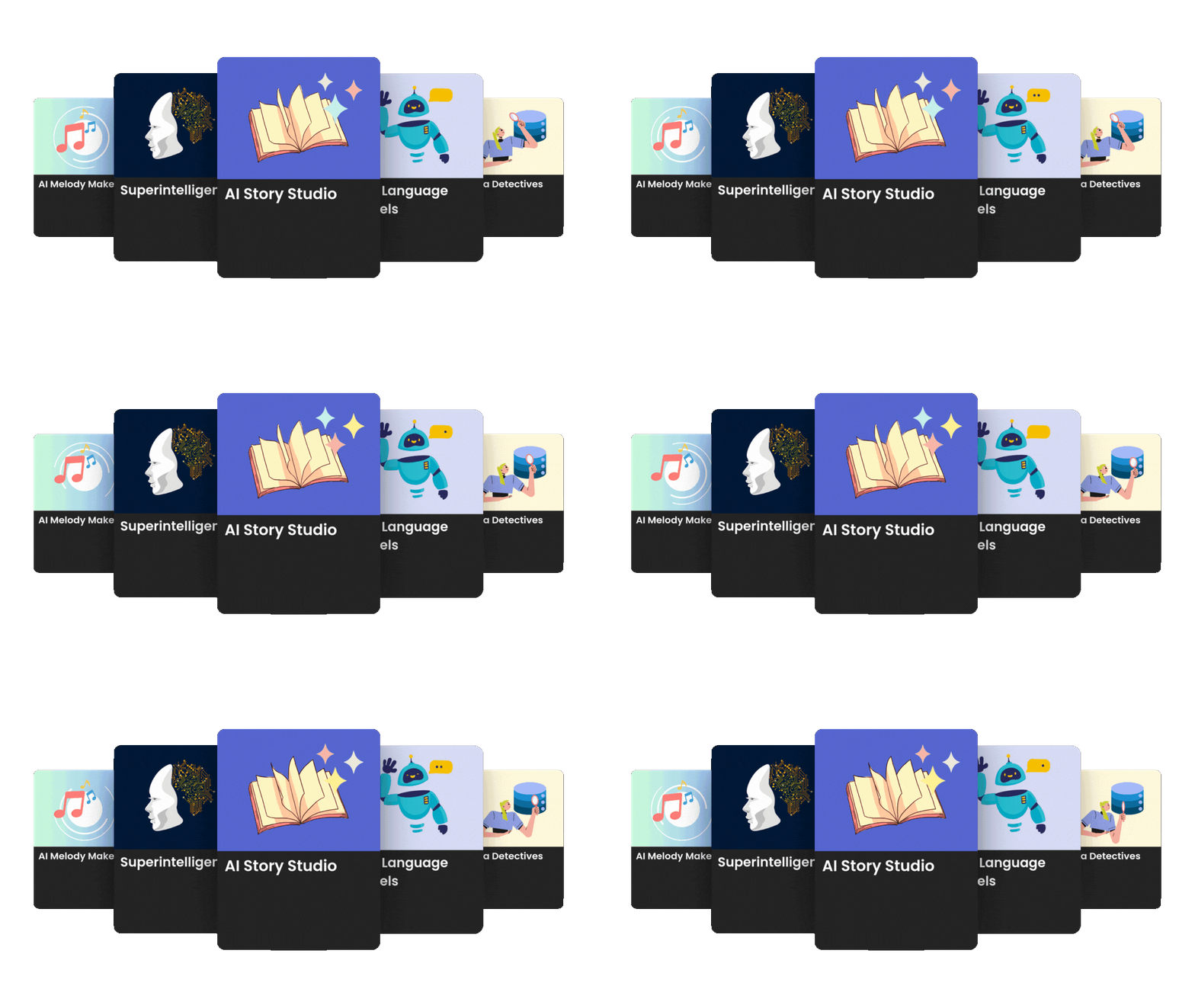
Most frameworks converge on the same core: understanding what AI is and how it works (including machine learning and data), using AI tools effectively, evaluating outputs critically, understanding ethical and societal impacts (bias, privacy, misinformation), and creating with AI rather than only consuming it. Hello World's AI courses cover each of these. AI Story Studio teaches AI basics through creative work, AI History Museum covers history and ethics, and Data Science & AI has high schoolers build AI tools in Python.
Several credible frameworks exist and they overlap heavily: AI4K12's Five Big Ideas (the most K-12-specific), the OECD AI Literacy Framework, Digital Promise's framework, and ISTE's standards. Rather than choosing one from scratch, most districts adopt curriculum that is already mapped to recognized standards. Hello World's courses are aligned to CSTA and state CS standards, which increasingly incorporate AI concepts directly. See the standards alignment for details.
Critical AI literacy goes beyond knowing how to use AI to questioning it: Who built this tool and why? What data was it trained on? Who benefits and who might be harmed? Is this output accurate, and how would I know? It treats AI as a technology shaped by human choices, not a neutral oracle. Hello World's AI History Museum is built around exactly these questions, with students exploring the evolution of AI and tackling privacy, bias, and societal impact.
AI literacy is a natural extension of computer science education. It builds on the same foundations (algorithms, data, how computers process information), and the CSTA standards increasingly incorporate AI concepts directly. That's why Hello World teaches AI literacy inside its K-12 computer science curriculum rather than as a separate subject: students who understand how software works are far better positioned to understand how AI works. The free Hour of AI activity, "LLMs: Math, not Magic," makes that connection explicit.
Yes, and most currently don't have it. Teachers report low confidence with AI tools and even less confidence teaching about them. Effective AI literacy programs include teacher professional development that covers both the concepts and the classroom practice: how to discuss AI with students, how to set expectations for AI use in schoolwork, and how to model responsible use. Hello World's professional development requires no programming experience and pairs every partnership with a dedicated PD specialist.
No. Learning to prompt a chatbot is a narrow skill, and the tools change every few months. AI literacy is about the durable understanding underneath: how these systems generate outputs, why they make mistakes, what data they draw from, and how to evaluate what they produce. Hello World's courses have students use AI to extend their own creative work rather than offload it, then program with AI-enabled code themselves. Students who understand those fundamentals can pick up any new tool.
Hello World built four layers of AI safety into its platform so students can learn about and create with AI in a controlled environment rather than on open commercial tools. Teachers also have access controls, and students agree to a Code of Ethics covering integrity and respect in their work. See the data security overview for how student information is handled.
Look for alignment to recognized standards, a real grade-level progression rather than a single one-off unit, hands-on activities where students build with AI rather than just discuss it, explicit attention to ethics and bias, built-in safety controls, and teacher professional development included. Be cautious of curriculum that is really product training for a specific AI tool. Hello World's AI curriculum runs from grades 3 through 12 and is available to try through a free teacher account.
Hello World's AI literacy curriculum spans elementary through high school. Younger students can start with the free AI 360°, middle schoolers add AI Book Hook, AI Career Convos, AI Story Studio and AI History Museum, and high schoolers build real AI tools in Data Science & AI. Teachers can get free access to projects now, and districts can request a pilot for full curriculum and PD.